
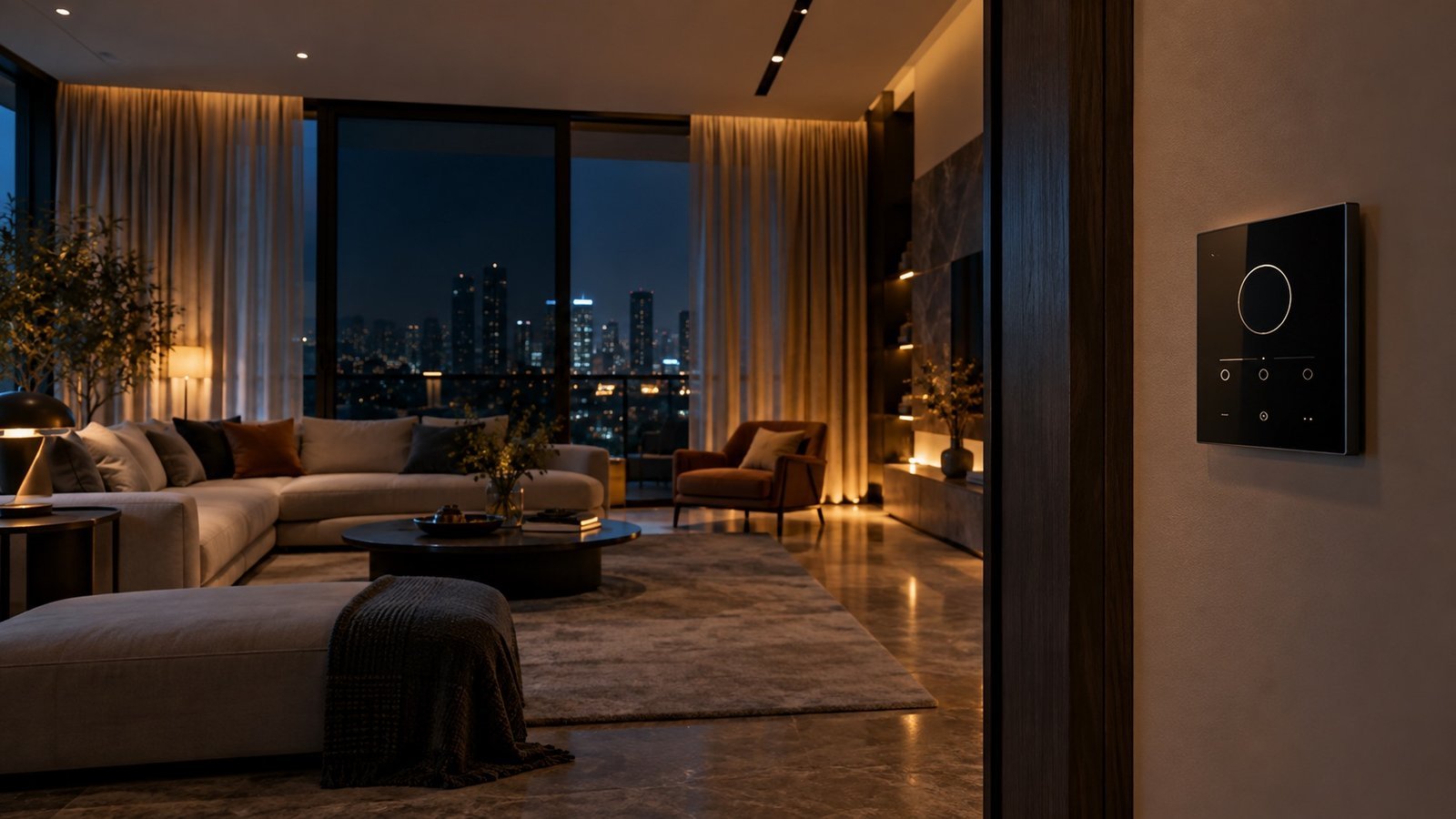
Wired home automation, such as KNX or a manufacturer's own bus system, is the more reliable and scalable choice for new builds and major renovations, because control signals travel on a dedicated cable rather than a crowded radio band. Wireless systems using Wi-Fi or Zigbee are better for retrofits and smaller homes, where opening walls is not practical. Many homes end up with a hybrid: wired for lighting, curtains and climate, wireless for add-ons.
The wired vs wireless home automation decision is best made early, ideally while the electrical drawings are still being prepared. Once walls are plastered and ceilings closed, your options narrow quickly. This guide explains how each approach works, how they behave during load-shedding, and which questions to settle before construction starts.
How wired home automation works
In a wired system, switches, sensors and actuators share a low-voltage control cable, known as a bus, that runs alongside the normal power wiring. The best-known open standard is KNX, defined in EN 50090 and ISO/IEC 14543-3. A KNX twisted-pair bus runs at around 29 V DC and connects devices from many different manufacturers, which can all be programmed to work together.
Lighting and curtain circuits are typically wired back to actuators in a distribution board. The wall keypad does not switch the load itself; it sends a message on the bus, and the actuator in the panel switches the circuit. This centralised layout makes wired systems tidy to service and easy to change later: reprogramming a scene or moving a keypad function is a software change, not a rewiring job.
Some manufacturers also offer their own bus protocols alongside KNX. HDL, for example, makes wired bus-based systems as well as KNX-compatible products, covering lighting, curtains, HVAC and audio.
How wireless home automation works
Wireless systems send control signals over radio. The common options are:
- Wi-Fi: devices join your home router directly. Easy to set up, but each device adds load to the network, and a busy or weak Wi-Fi network means sluggish or unreliable control.
- Zigbee: a low-power mesh network in which mains-powered devices relay signals for each other. It needs a hub or gateway but keeps automation traffic off your Wi-Fi.
- Thread and Matter: newer standards aimed at making devices from different brands work together, with growing but still uneven product support.
Wireless switches and relays usually fit into existing back boxes, which is why they suit retrofits. Battery-powered sensors can be placed almost anywhere without cabling.
Wired vs wireless home automation compared
| Factor | Wired (KNX / bus) | Wireless (Wi-Fi / Zigbee) |
|---|---|---|
| Reliability | Very high; dedicated cable, no radio interference | Good when well designed; affected by walls, distance and interference |
| Best suited to | New builds, full renovations, larger homes | Retrofits, apartments, smaller projects |
| Installation | Bus cable planned with electrical wiring; actuators in panels | Devices in existing back boxes; little or no new cabling |
| Scalability | Hundreds of devices on a properly designed installation | Depends on hub, mesh quality and network capacity |
| Interoperability | KNX is an open standard with many manufacturers | Varies by ecosystem; Matter is improving this |
| Maintenance | No batteries in wall devices; centralised panels | Battery replacements for sensors; firmware and app updates |
| Upfront cost | Higher, mainly for cabling, actuators and programming | Lower to start, especially for a few rooms |
Reliability and everyday use
The biggest practical difference is how the system feels day to day. On a wired bus, a keypad press reaches its actuator over a cable, so lights respond consistently regardless of how many phones are streaming video in the house. Wireless systems can be very good, but they depend on radio coverage. Thick concrete walls and slabs, common in Pakistani construction, weaken signals between floors, and a crowded 2.4 GHz band in dense neighbourhoods and apartment blocks adds interference.
A well-designed wired system also keeps working locally if the internet goes down. Many wireless products work locally too, but some rely on a cloud service for scenes or app control, so it is worth checking what still works when the internet is off.
Power cuts, UPS and load-shedding
In Pakistan, behaviour during power cuts is a real design question, not an edge case.
Wired systems
A KNX or bus system needs its bus power supply, and any IP gateway or controller, to be on backup power. Put these on a UPS or on circuits fed by the inverter or generator, and the control layer stays alive through load-shedding. Actuators can also be arranged so that circuits on backup power remain controllable while non-essential loads stay off.
Wireless systems
Wi-Fi devices only work if the router, and any hub, are also on backup power. Zigbee mesh networks may need time to re-form after an outage if the repeating devices lost power. Battery sensors keep working, but smart relays behind switches go dark with their circuit. When power returns, check what state devices come back in: some default to on, which matters for lights and appliances when the family is away.
Whichever route you choose, agree with your electrician and automation designer which circuits are on UPS or inverter backup, and make sure the automation equipment is among them.
Retrofit or new build?
For a new build or full renovation, wired is usually worth it. The additional bus cable is inexpensive compared with the building work, and it gives you a foundation that can be reprogrammed for decades. It also lets you plan smart lighting control properly, with dimming, scenes and sensor control designed around the lighting layout rather than added afterwards.
For an occupied home or apartment, wireless avoids chasing walls. Choose products that fit standard back boxes, check that a neutral wire is available where the device needs one, and put a proper hub and good Wi-Fi coverage in place before adding devices.
A hybrid approach is common: a wired backbone for lighting, curtains and air-conditioning, with wireless sensors, locks or plug-in devices added where cabling would be awkward. Most serious platforms, KNX included, have gateways that link wired and wireless devices.
When to decide during construction
If you want a wired system, the decision needs to be made before first-fix electrical work. At that stage you should have:
- A room-by-room list of what you want to control: lighting circuits, dimming, curtains and blinds, air-conditioning, audio, gates and security.
- Keypad and sensor positions marked on the electrical drawings.
- Space allocated in distribution boards, or a separate automation panel, for actuators and power supplies.
- A decision on which circuits and devices are on UPS or inverter backup.
- Network cabling to the automation panel, access points and any touch panels.
Getting these into the drawings costs little. Adding them after plastering costs a great deal more, which is why many homeowners end up with wireless by default rather than by choice.
Choosing a home automation company
Whether you are looking for a home automation company in Karachi, Lahore or Islamabad, ask to see the proposed system architecture, not just a product list. A good proposal shows which protocol is used where, how the system behaves without internet or mains power, who programs it, and how changes are handled after handover. Resco designs, supplies, installs and maintains smart home systems from offices in Karachi, Lahore and Islamabad; you can see what we cover on our smart home automation page.
Frequently asked questions
Is wired or wireless home automation better?
Wired automation such as KNX is more reliable and scalable, and is usually the better choice for new builds and full renovations. Wireless systems using Wi-Fi or Zigbee are better for retrofits and smaller homes where new cabling is impractical.
What is KNX home automation?
KNX is an open standard for home and building automation, defined in EN 50090 and ISO/IEC 14543-3. Devices from many manufacturers share a low-voltage bus cable and can be programmed to work together for lighting, curtains, climate and security.
Does smart home automation work during load-shedding?
It can, if designed for it. Put the bus power supply, controllers, router and hubs on a UPS or inverter-backed circuit, and check how each device behaves when power returns. Devices on circuits without backup will be unavailable until mains power is restored.
When should I decide on home automation during construction?
Before first-fix electrical work. Keypad positions, bus cabling, panel space for actuators and backup power arrangements all need to be in the electrical drawings. After plastering, a wired system becomes much harder and more expensive to install.
Planning a new home or renovation? Request a proposal and our team will help you choose the right approach, or contact Resco on +92 21 36378960-2 or at info@resco.com.pk.