
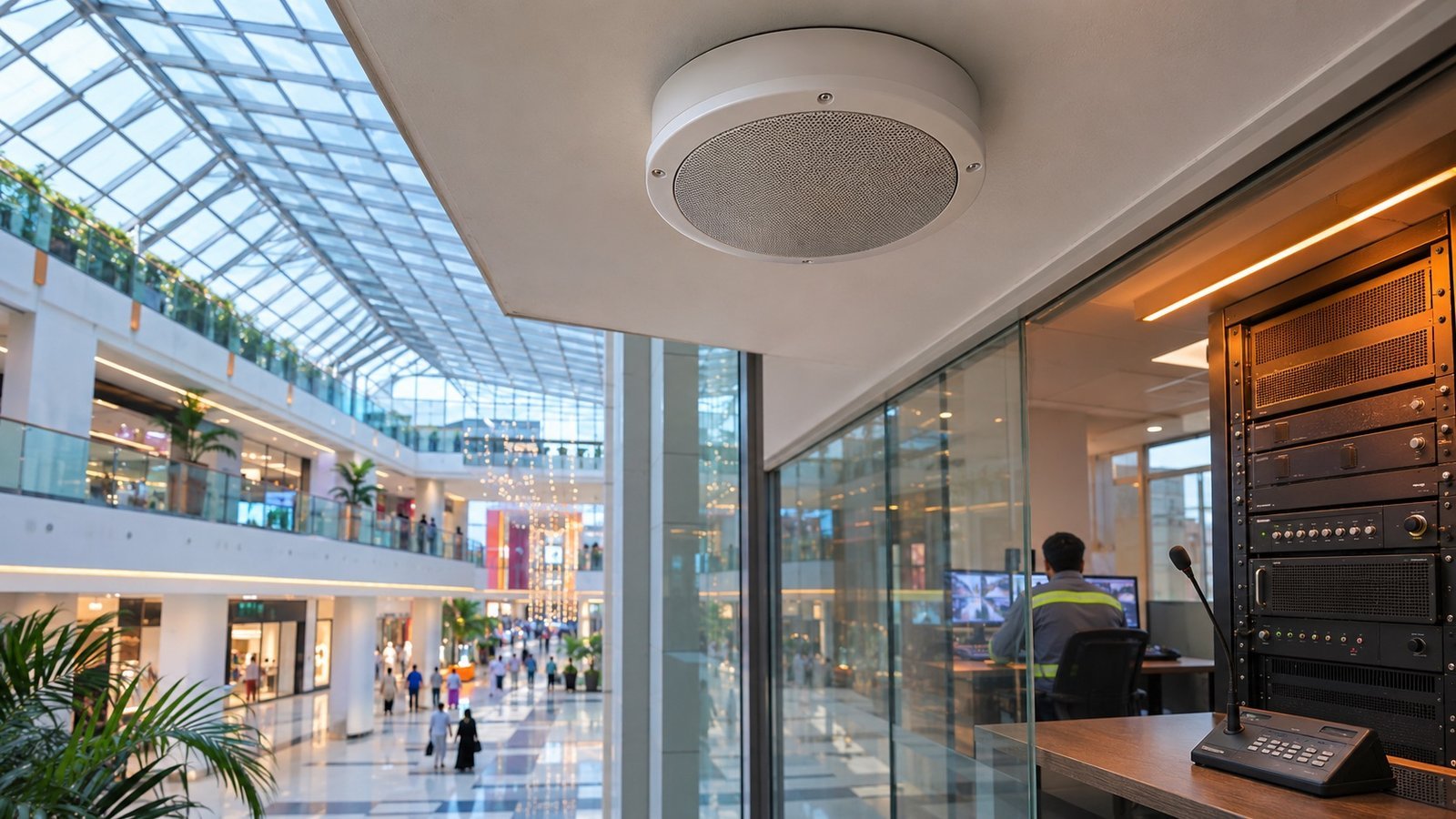
A public address and voice alarm system (PAVA) is a single sound system that handles everyday paging and background music and, when the fire alarm operates, broadcasts automatic spoken evacuation messages to the right zones. The voice alarm part is life-safety equipment: it should use certified control equipment and loudspeakers, monitor its own circuits, keep running on battery backup and deliver speech people can understand. That is what separates it from an ordinary PA system.
This guide explains how PA and voice alarm differ, which standards are commonly specified, and what to check in a design for an office, mall, hospital or airport.
PA vs voice alarm vs PAVA
| Aspect | Public address (PA) | Voice alarm (VA) |
|---|---|---|
| Purpose | Paging, announcements, background music | Emergency alert and evacuation messages |
| Trigger | Operators, schedules, music sources | Fire alarm signals, plus manual emergency microphone |
| Equipment standard | General audio equipment | Certified control equipment, power supplies and loudspeakers, for example EN 54-16, EN 54-4 and EN 54-24 |
| Monitoring | Usually none | Amplifiers, loudspeaker lines, microphones and power continuously monitored for faults |
| Power | Mains | Mains with standby batteries |
| Intelligibility | Desirable | Designed and measured to a target, commonly STI 0.50 |
A PAVA system combines both: the same amplifiers and loudspeakers carry music and paging day to day, and the emergency function takes priority whenever it is needed.
Why voice messages evacuate better than sounders
A bell or electronic sounder tells people something is wrong but not what to do. Many occupants wait, look for confirmation or carry on working. A study by fire safety researcher David Purser, comparing a sounder with two voice alarm messages, found that voice alarms gave shorter and more reliable pre-movement times than the sounder, especially where occupants were awake but unfamiliar with the building, such as shoppers, hospital visitors and travellers. The study was prompted partly by concern that people may become less responsive as voice announcements become more common, which is a good reason to keep emergency messages clear and short and to keep them for real events and planned tests.
A voice message can also give instructions: which exit to use, not to use the lifts, or to wait for further instructions on floors that are not yet evacuating. That makes phased evacuation possible.
Standards commonly specified
Pakistani projects usually follow either European and British standards or NFPA, depending on the consultant.
- EN 54-16 covers voice alarm control and indicating equipment (VACIE), the racks that store messages, select zones, drive amplifiers and report faults. Its power supply is covered by EN 54-4.
- EN 54-24 covers loudspeakers used in voice alarm systems. EN 54-16, EN 54-4 and EN 54-24 are harmonised European product standards, so compliant equipment is tested and certified by a notified body.
- BS 5839-8 is the British code of practice for the design, installation, commissioning and maintenance of voice alarm systems. The current edition, BS 5839-8:2023, is a full revision of the 2013 edition and covers the interface with the fire detection system, loudspeaker zoning, fault monitoring and intelligibility measurement. CEN/TS 54-32 gives similar European planning and design guidance.
- NFPA 72, the National Fire Alarm and Signaling Code, covers emergency communications systems in Chapter 24, including in-building fire emergency voice/alarm communications systems. The Building Code of Pakistan Fire Safety Provisions 2016 refers to NFPA 72 for fire alarm systems and calls for an approved emergency voice/alarm communication system in high-rise buildings.
Whichever standard your consultant names, ask for product certificates for the control equipment, power supplies and loudspeakers, and for a design and commissioning report against that standard. Mixing certified racks with uncertified loudspeakers weakens the whole system.
Zones and phased evacuation
Loudspeakers are grouped into zones, usually by floor, wing or fire compartment, and matched to the fire alarm zones. In a high-rise building or hospital, total evacuation at once is often impractical, so the system plays an "evacuate" message on the fire floor and the floors next to it, and an "alert" message telling other floors to stand by. The cause and effect is agreed in advance and programmed into the fire alarm and voice alarm systems together. Stairs, lift lobbies, car parks and plant rooms need their own zones and messages.
Speech intelligibility (STI)
Loud is not the same as clear. Hard surfaces in atriums, car parks and stairwells cause echoes, and background noise masks speech. Intelligibility is measured with the Speech Transmission Index (STI), from 0 to 1. Common voice alarm guidance, for example under EN 50849 and CEN/TS 54-32, sets a target of STI 0.50 or better. NFPA 72 asks designers to define acoustically distinguishable spaces and decide which need intelligible voice, with test guidance in an informative annex. Good intelligibility comes from more loudspeakers at lower power, the right loudspeaker types for each space, sensible ceiling heights and acoustic modelling for difficult areas, then on-site measurement at commissioning.
Amplifier redundancy and line supervision
- Standby amplifiers: if a duty amplifier fails, a spare switches in automatically.
- A/B loudspeaker circuits: alternate loudspeakers in a zone are wired on two circuits, so a single cable fault does not silence the zone.
- Line supervision: loudspeaker lines are monitored for open circuits, short circuits and earth faults, and the system reports faults at the control panel.
- Cable survivability: fire-resistant cable and routing that keeps circuits working long enough for the evacuation.
Battery backup
A voice alarm must keep working when the mains fails. Guidance commonly cited under EN 50849 and CEN/TS 54-32 is 24 hours of standby followed by 30 minutes in alarm, but the required figures depend on the standard and the approving authority, so confirm them for each project. Battery sizing must include every amplifier that would be active in a full alarm, not just the standby load.
Fire alarm interface and cause and effect
The fire alarm system triggers the voice alarm through monitored interfaces, so a broken link is reported as a fault. The cause-and-effect matrix sets which detector or call point activates which message in which zone, and in what order. When an emergency message starts, background music and paging must be muted or overridden automatically. A fire microphone at the control room or fire command point lets trained staff give live instructions. The voice alarm should also be coordinated with emergency lighting and evacuation systems, door releases and lift control.
Background music and paging in different buildings
- Malls: background music by area, promotional announcements, and phased evacuation across large open floors and car parks.
- Hospitals: calm, low-level paging, quiet zones around wards, and phased evacuation where patients cannot move quickly.
- Airports: scheduled flight announcements, many zones and high background noise, which make intelligibility design critical.
- Offices: occasional paging and music in lobbies, with floor-by-floor evacuation in towers.
Maintenance
A voice alarm needs routine testing like a fire alarm: checking fault indications, playing messages in each zone, testing the fire alarm interface, checking batteries and the standby amplifier changeover, and re-checking intelligibility after fit-outs that change ceilings or partitions. Keep a logbook and record every fault and its repair.
Frequently asked questions
What is the difference between a PA system and a voice alarm system?
A public address system carries paging, announcements and background music. A voice alarm system broadcasts emergency evacuation messages, is triggered by the fire alarm, and is built to life-safety rules: monitored circuits, backup power and certified equipment. A PAVA system does both on one installation, with emergency messages always taking priority.
Which standards apply to a public address and voice alarm system?
In European-influenced specifications, EN 54-16 covers the voice alarm control and indicating equipment, EN 54-4 its power supply and EN 54-24 the loudspeakers, with BS 5839-8 as the code of practice for design, installation, commissioning and maintenance. NFPA-based projects use NFPA 72, whose Chapter 24 covers emergency communications systems.
Why use voice messages instead of fire alarm sounders?
Research on evacuations has found that recorded voice messages can produce shorter and more reliable pre-movement times than sounders, especially for occupants who are awake but unfamiliar with the building. A spoken message also tells people what to do and where to go, which a bell cannot.
What is STI and what value should a voice alarm achieve?
The Speech Transmission Index is a 0 to 1 measure of how intelligible speech is at a given point. Voice alarm guidance commonly targets an STI of 0.50 or better in the areas that must hear messages, and the target spaces should be agreed at design stage.
Can the same system play background music and paging?
Yes. Malls, hospitals, airports and offices commonly use one PAVA system for music, paging and emergency messages. The fire alarm interface must mute or override music and paging automatically when an emergency message starts.
Resco designs and installs digital public address and voice alarm systems as part of its wider fire and life safety work, from its Karachi head office and its Lahore and Islamabad offices. For the wider code context, see our guide to fire alarm requirements under the Building Code of Pakistan. To plan a PAVA system for your building, request a proposal, call +92 21 36378960-2 or email info@resco.com.pk.