
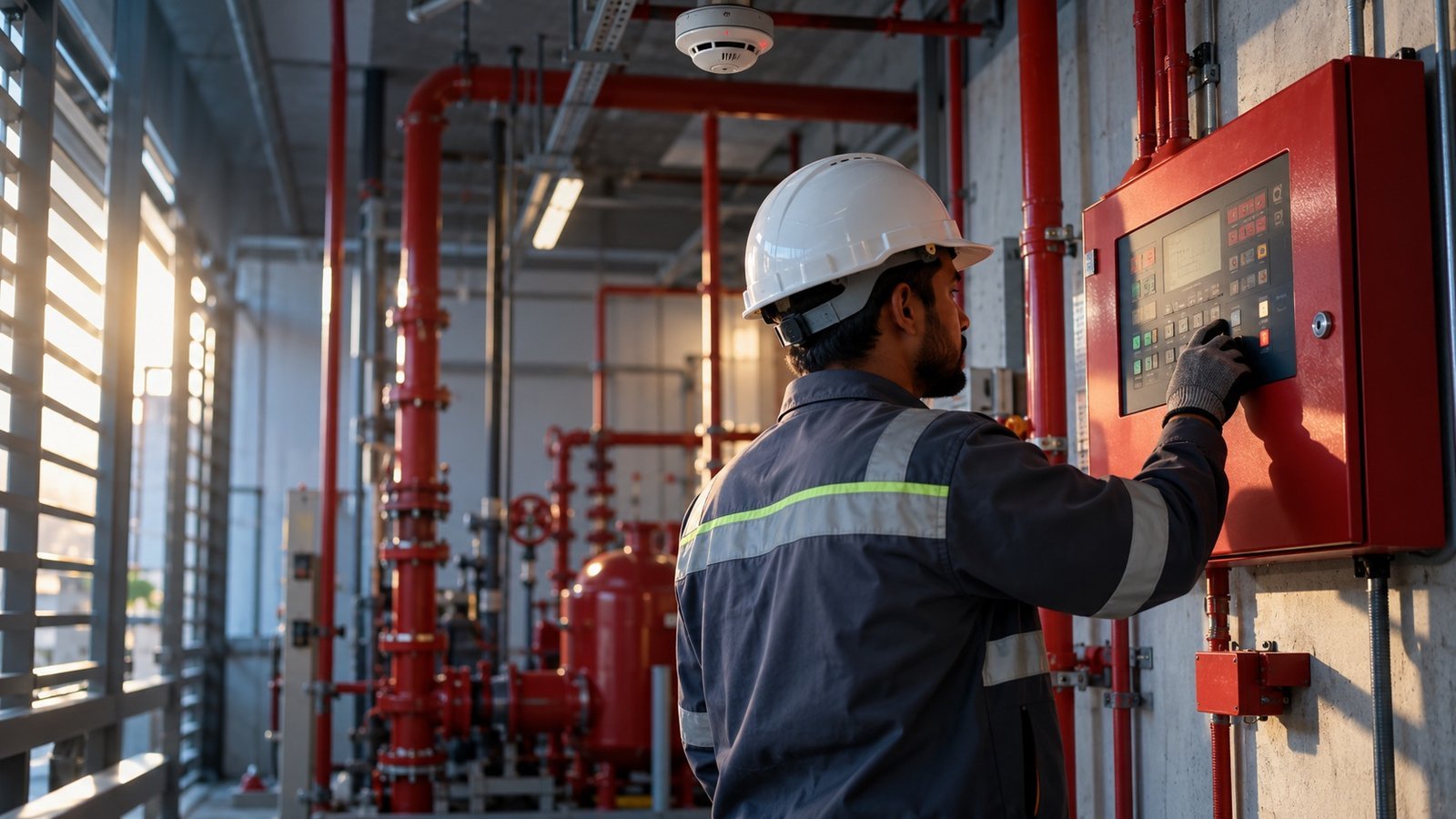
A conventional fire alarm tells you which zone an alarm came from; an addressable fire alarm tells you exactly which detector or call point raised it. Conventional systems suit small, simple buildings such as shops, small offices and bank branches, while addressable systems are the normal choice for hospitals, high-rises, factories, campuses and any building where fast, precise response and integration with other systems matter.
The conventional vs addressable fire alarm decision affects cabling, commissioning, day-to-day fault finding and how well the system works with voice evacuation, access control and your building management system. This guide explains how each type works and when each one fits.
How a conventional fire alarm works
In a conventional system, the building is divided into zones, typically one per floor or fire compartment. Each zone is a radial circuit that runs from the panel out to a group of detectors and manual call points and ends at an end-of-line device. The panel watches the current on each circuit. When a detector goes into alarm it draws more current, and the panel shows "Fire, Zone 3". A cable break or missing end-of-line device shows as a zone fault.
The panel knows the zone, not the device. Staff then walk the zone, looking for the detector with its indicator lit or the broken call point glass. In a small building this takes moments. In a large floor plate with ceiling voids and plant rooms, it takes longer, and time matters in a fire.
Conventional detectors are simple devices that switch into alarm at a fixed threshold. Sounders are wired on separate circuits, and there is no individual monitoring of each detector's condition.
How an addressable fire alarm works
In an addressable system, every detector, call point, sounder and interface module has its own address. Devices are wired on a loop (often called a signalling line circuit) that leaves the panel, passes through each device and returns to the panel. The panel polls each device continuously, so it knows the state of every one of them.
When an alarm occurs, the panel shows a text location such as "Smoke detector, Level 4, Server Room". Faults are reported the same way, down to a dirty or missing detector. With analogue addressable detectors, the panel reads the actual smoke or heat level, can compensate for gradual contamination and flags detectors that need cleaning before they cause false alarms.
A single loop can carry well over a hundred devices, depending on the manufacturer and protocol, and larger panels support several loops. Panels can be networked across buildings, which suits hospitals and campuses.
Why loops are more resilient
Because the loop starts and ends at the panel, a single cable break does not take devices out of service: the panel drives the loop from both ends. Short-circuit isolators, built into devices or fitted as separate modules, divide the loop into sections. If a short occurs, the isolators on either side open and only that section is lost. A short on a conventional zone, by comparison, can disable the whole zone until it is found and repaired.
Conventional vs addressable fire alarm: side-by-side
| Factor | Conventional | Addressable |
|---|---|---|
| Alarm location | Zone only | Individual device, with text description |
| Wiring | One radial circuit per zone, plus sounder circuits | Loops carrying detectors, call points, sounders and modules |
| Cable break | Devices beyond the break are lost | Loop fed from both ends, devices stay online |
| Fault reporting | Zone fault | Device-level fault, including dirty or removed detectors |
| False alarm control | Limited | Drift compensation, adjustable sensitivity, multi-sensor detectors |
| Cause-and-effect logic | Basic, per zone | Programmable per device, zone or area |
| Integration | Relay outputs | Input/output modules plus network interfaces to BMS and graphics |
| Equipment cost | Lower per device and per panel | Higher per device, but less cable in large buildings |
| Best fit | Small, simple buildings with few zones | Medium to large, complex or high-risk buildings |
The cost trade-off
Conventional equipment is cheaper per detector and per panel, and for a building with a handful of zones it is usually the lower-cost option overall. As the building grows, the picture changes. Every extra conventional zone needs its own cable run back to the panel, while one addressable loop can cover a large area. Labour for cabling is a significant part of any fire alarm installation, so in larger buildings the gap in total installed cost narrows.
Running costs matter too. Addressable systems cut the time spent finding faults, reduce false alarms through better detection and give maintenance technicians device-level information during routine tests. A conventional system that produces repeated false alarms in a busy building can cost more in disruption than it saved at purchase.
Which one fits your building?
Where conventional makes sense
- Small shops, showrooms and single-floor offices
- Bank branches, clinics and small schools with a few zones
- Budget-driven projects where the layout is simple and staff can reach any detector quickly
Where addressable is the better choice
- Hospitals and healthcare buildings, where staged evacuation and precise location are essential
- High-rise offices, hotels and apartments
- Factories and warehouses with large floor areas, plant rooms and hazardous processes
- Universities and campuses with several buildings on a network
- Any building that needs detailed cause-and-effect with lifts, HVAC, smoke control and doors
In Pakistan, the Building Code of Pakistan Fire Safety Provisions 2016 refers to NFPA 72 for fire alarm design, and requires an emergency voice/alarm communication system in high-rise buildings. Neither the code nor NFPA 72 dictates conventional or addressable; the choice follows from the building's size, risk and the functions the system must perform. Our fire alarm systems page covers the options we design and install.
Integration with voice evacuation, access control and BMS
Integration is often what decides the question for larger buildings.
- Voice evacuation. In high-rise buildings, hospitals and malls, a phased evacuation is safer than a single building-wide bell. An addressable panel can tell a voice alarm system exactly which floors to evacuate and which to alert, with pre-recorded messages. See our public address and voice alarm page.
- Access control release. Fire codes require locked doors on escape routes to release on alarm. Addressable output modules can release specific doors or whole areas, and the access control system can log the event.
- Lifts, HVAC and smoke control. Lift homing, air handling unit shutdown, damper control and stair pressurisation can be triggered from the exact detector or zone involved.
- BMS and graphics. Many addressable panels offer network interfaces, such as BACnet or Modbus gateways, so the BMS or a graphics workstation can show alarm and fault locations on floor plans. The fire panel always remains the controlling system for life safety functions.
Conventional panels can still drive these functions through relay outputs, but usually per zone rather than per device, and with far less information passed to other systems.
Upgrading from conventional to addressable
Many older buildings in Pakistan still run conventional panels. An upgrade is worth considering when the building has been extended, false alarms are frequent, spare parts are hard to find or the building now needs voice evacuation or BMS integration. Existing cable can sometimes be reused if it is fire-rated and in good condition, but loops have different wiring rules, so a survey is needed first. Planned testing and maintenance also matters for either type; our maintenance and support service covers this.
Frequently asked questions
What is the main difference between conventional and addressable fire alarms?
A conventional system reports an alarm by zone, so staff must search the zone to find the device. An addressable system gives each device its own address and reports the exact detector or call point, with a text location, on the panel.
Is an addressable fire alarm system more expensive?
The equipment costs more per device, but addressable loops need less cabling than many separate conventional zones. In small buildings conventional is usually cheaper; in medium and large buildings the total installed cost gap narrows and running costs are often lower.
Which fire alarm system is best for a factory?
Most factories benefit from an addressable system because of their large floor areas, plant rooms and process hazards. Precise alarm location, fewer false alarms and interfaces to machinery shutdown, HVAC and doors are usually worth the extra equipment cost.
Can a conventional fire alarm work with voice evacuation?
Yes, through relay outputs per zone, but control is limited. For phased evacuation in high-rise or healthcare buildings, an addressable panel gives more precise control over which areas receive evacuate or alert messages.
Resco has designed, supplied, installed and maintained building systems in Pakistan since 1990, with offices in Karachi, Lahore and Islamabad. If you are choosing between conventional and addressable for a new building or an upgrade, request a proposal or contact us on +92 21 36378960-2 or info@resco.com.pk.